
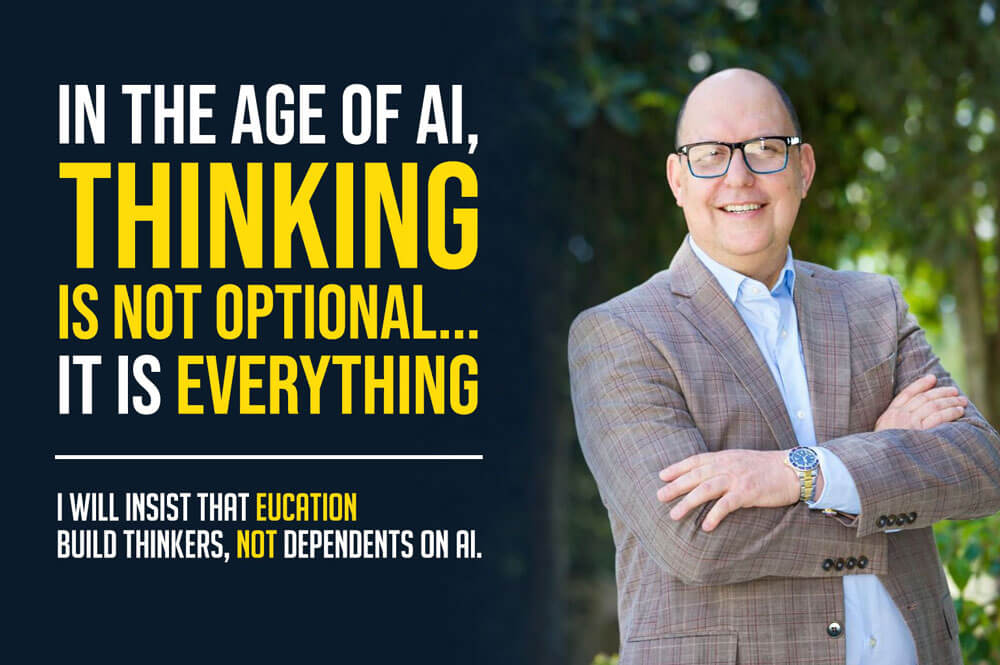
We are entering a moment that demands honesty. Artificial Intelligence has not just introduced a new tool into education — it has exposed a weakness that has been building for years. When answers can be generated in seconds, we must confront a difficult truth: were we truly educating… or simply training students to produce outputs
For too long, systems have rewarded completion over comprehension. Assignments were done, exams were passed, results were achieved — but how much real thinking was taking place beneath the surface?
Now AI has changed the equation.
If a machine can write, summarise, calculate and even argue — then the real value of education can no longer be the answer itself. The value must be in the thinking behind it. In the ability to question, to judge, to challenge, and to understand.
And this is where a new dimension emerges — one that many are still overlooking.
Because today, cognitive skills are no longer only about solving problems… they are about asking the right questions.
They are about crafting the right prompts.
The ability to write a clear, precise, intelligent prompt that produces the best and most accurate answer — this is cognitive strength in action.
It requires reasoning. It requires understanding. It requires clarity of thought.
In simple terms: Better thinking → Better prompts → Better answers.
So the argument shifts. AI does not remove thinking. It demands better thinking. This is the new literacy of our time.
But here lies the concern. If we allow uncontrolled reliance on AI without developing these cognitive skills, we risk weakening the very foundation needed to use it effectively. Thinking becomes shallow. Prompts become lazy. Answers become misleading. Dependency grows — quietly, but dangerously.
This is not a technology problem. It is a leadership problem.
Policymakers, educators, and parents must all ask themselves the same uncomfortable question: are we preparing our students to think deeply enough to use AI intelligently… or are we allowing convenience to replace cognition?
Because the danger is not that students will use AI. The danger is that they will use it without thinking.
The future of education will not be defined by access to tools. It will be defined by the quality of thinking behind every prompt, every question, and every decision.
For Malta, this is a defining opportunity. We can lead by embedding cognitive skills at the core of education — teaching students not just to use AI, but to challenge it, refine it, and guide it through intelligent prompting. Or we can fall into the trap of introducing technology without transformation.
We must rethink assessment. We must empower teachers. We must guide parents.
And above all, we must recognise this new reality: Cognitive skills now shape the quality of prompts — and prompts shape the quality of outcomes.
Because the real divide of the future will not be digital. It will be cognitive. And that divide will define nations.
The responsibility now sits with us — those shaping policy, those teaching in classrooms, and those raising the next generation. We cannot afford to get this wrong.
I WILL INSIST that education in Malta evolves to build thinkers who can question, reason, and prompt with intelligence — because in the age of AI, thinking is not optional… it is everything.