
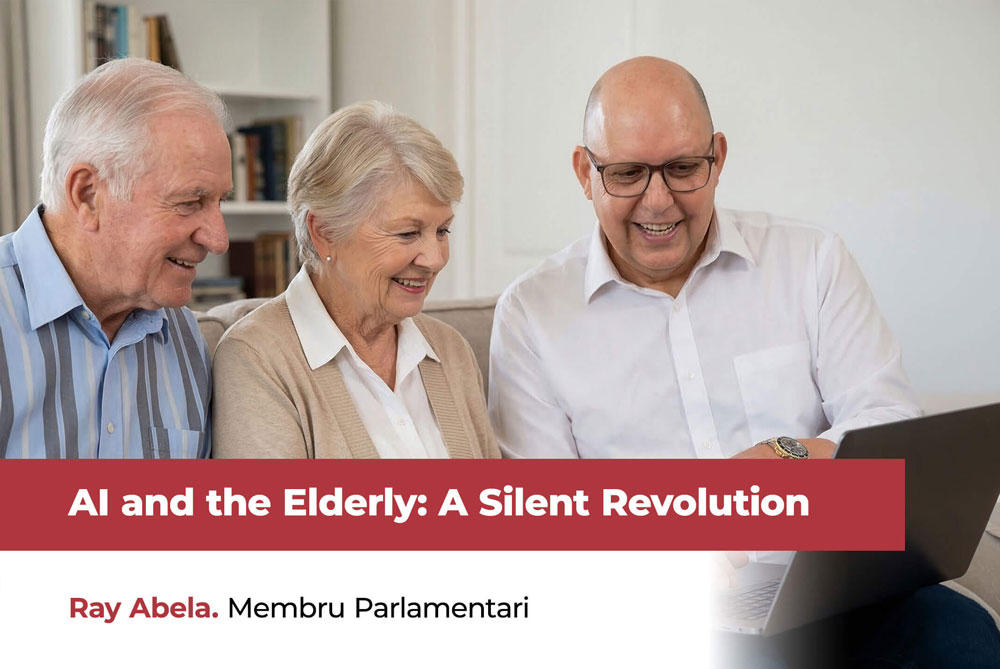
Artificial Intelligence (AI) is often associated with advanced technology and younger generations. However, the reality is that AI can serve as an invaluable tool in helping elderly individuals lead more independent, safer, and more socially connected lives.
In recent years, we have witnessed new technologies becoming increasingly integrated into daily life. For many elderly people, the rapid pace of technological advancement can at times appear daunting and difficult to navigate. This is precisely where the true potential of Artificial Intelligence lies: in rendering technology simpler, more human-centred, and more accessible to all.
Today, AI-powered systems are capable of functioning as personal in-home assistants. An elderly person can simply speak to a device or application and pose straightforward questions regarding news, medications, or even to seek clarification on correspondence received from their bank or hospital. Rather than having to search for complex information online, they are able to receive clear and immediate explanations.
AI can also provide considerable assistance in the management of personal health. Intelligent devices are capable of reminding individuals when to take their medication, as well as assisting in the monitoring of certain health indicators. For elderly individuals living alone, this generates a greater sense of security — both for themselves and for their families.
Another significant dimension is connectivity with family and the wider community. One of the foremost challenges faced by many elderly people is the experience of loneliness and social isolation. With the assistance of AI, elderly individuals can send messages, compose emails, or conduct video calls with their relatives, even if they possess limited familiarity with technology. In this way, technology becomes a bridge between generations, fostering meaningful human connection.
Furthermore, AI-based applications are capable of reading documents or letters aloud and rendering them in more accessible language. This is of considerable benefit to individuals experiencing visual impairment or those who occasionally find official documents challenging to comprehend.
Recently, I had the privilege of addressing a special session on Artificial Intelligence with the Veterans’ Association of the Labour Party. During this session, I provided a straightforward explanation of what AI is, how it is already influencing various aspects of our daily lives, and presented practical demonstrations of AI tools that are accessible to all.
The level of interest and engagement among the elderly participants was genuinely remarkable. Many of them enquired how these tools could assist them in searching for information, composing messages, or understanding new subjects within a matter of seconds. This demonstrated clearly that when technology is explained in a simple and practical manner, even older generations are able to embrace it with confidence.
This is, in fact, far from a new endeavour for me. Over the past thirty years, I have been at the forefront of promoting the adoption of technology across all generations. Throughout this period, I have organised and delivered numerous free sessions and courses in local councils across Malta and Gozo, through which hundreds of individuals — including many elderly people — took their first steps into the digital world. I have always held the conviction that technology should be accessible to all, and not merely to a privileged few.
Today, with the advancement of Artificial Intelligence, we are entering a new phase in which technology has the potential to become even simpler and more beneficial for everyone. AI can play a vital role in reducing isolation, fostering independence, and enhancing the quality of life of our elderly citizens.
As an educator and Member of Parliament, I firmly believe that the digital future must be an inclusive one. Technology should bring people closer together and provide them with new opportunities to remain active and engaged members of society.
As I myself maintain:
“Artificial Intelligence must not remain solely a technology of the future. It must serve as a tool of the present — one that empowers our elderly to live more independent, safer, and more connected lives, in communion with their families and with society at large.”