
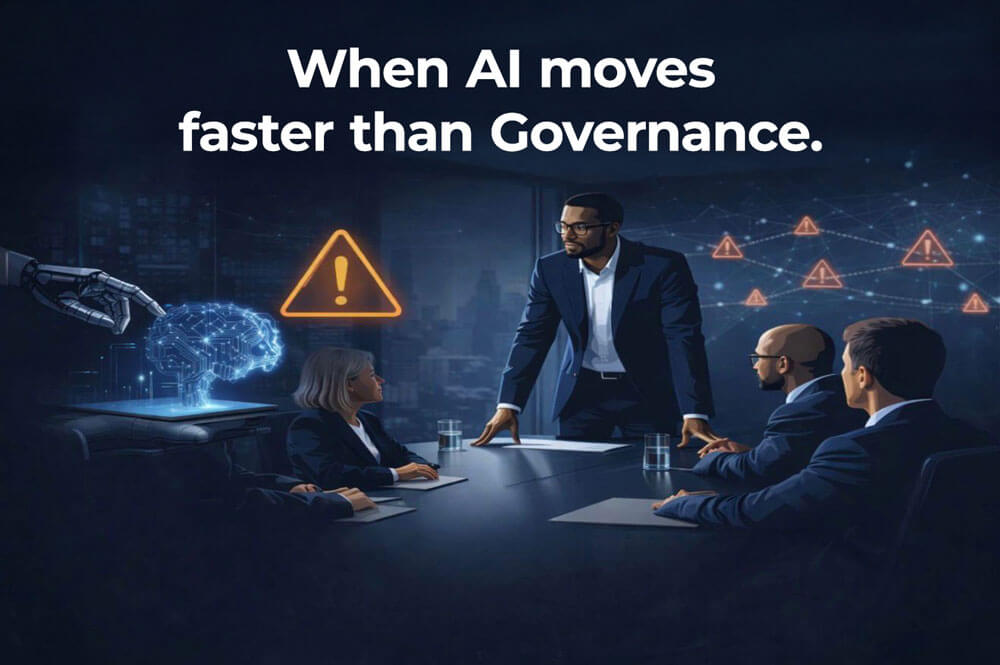
Artificial Intelligence is no longer a future concept. It is here — in our schools, businesses, hospitals, public administration, and even in our homes. Yet the real question is not whether we adopt AI. The real question is whether we lead it responsibly.
Technology alone does not transform nations. Governance does.
Across the globe, we are witnessing a rapid race to deploy AI tools. Companies experiment. Governments pilot systems. Executives announce strategies. But many initiatives stall — not because the technology fails, but because leadership structures, accountability frameworks, and governance mechanisms were never clearly defined from the outset.
As a Member of Parliament and Chair of the Parliamentary Committee on AI and Digital Affairs, I firmly believe that AI governance must precede AI expansion.
Governance is not bureaucracy. It is clarity. It defines:
Without governance, AI becomes experimentation. With governance, AI becomes transformation.
For Malta, this is particularly crucial. We are a small but agile nation. Our size allows us to move quickly — but speed without structure can damage trust. If we want AI to enhance productivity, improve public services, and create high-value careers for our youth, then leadership must come first.
Government has already invested significantly in digital infrastructure, education reform, and innovation ecosystems. But the next phase requires something deeper: embedding AI governance across all sectors — education, healthcare, justice, SMEs, financial services, tourism, and manufacturing.
This means training leaders, not just technicians.
It means equipping educators, not just students.
It means guiding boards and executives, not just IT departments.
AI governance must also align with skills policy. We cannot regulate what we do not understand. Therefore, continuous upskilling of public officials, business leaders, and workers is essential. Governance requires competence.
Most importantly, governance builds trust. Citizens will only embrace AI in public services if they know there are safeguards. Businesses will only scale AI if regulatory clarity exists. Investors will only choose Malta if we provide both innovation and stability.
This is the leadership test of our time.
AI is not simply about automation or efficiency. It is about shaping the future of work, decision-making, and public accountability. And leadership today means ensuring that technology serves society — not the other way around.
Malta has the opportunity to be not only an AI adopter, but an AI governance leader in Europe.
Because in the end, progress is not measured by how fast we deploy technology, but by how responsibly we guide it.
“Artificial Intelligence will shape our future — but Governance will determine whether that future is fair, secure, and truly human.”