
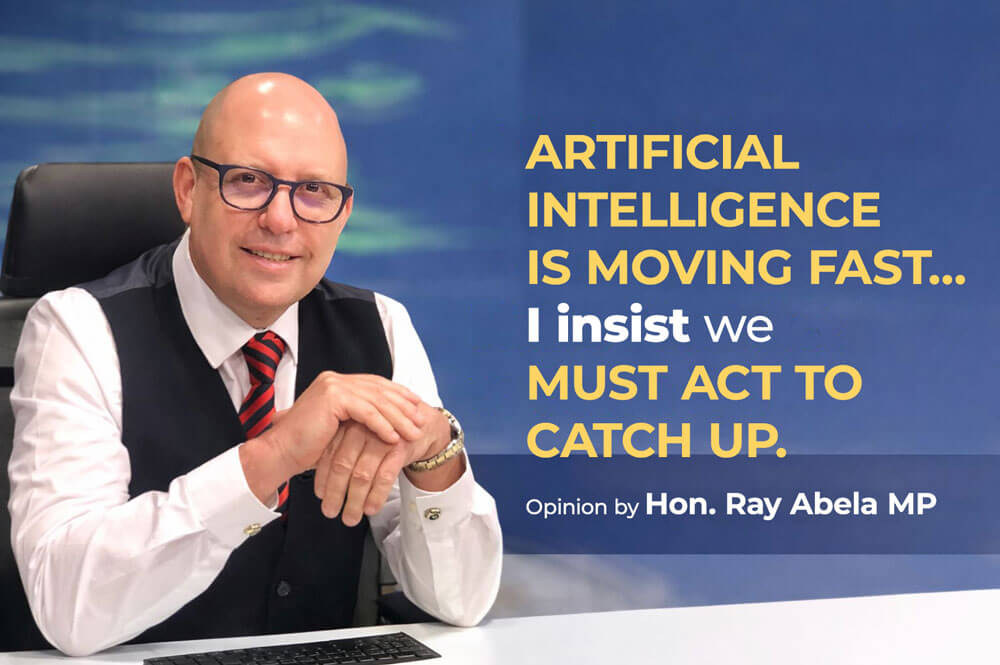
Artificial Intelligence is advancing at an extraordinary pace. Every day new tools appear that can write, analyse, design, diagnose and even make complex decisions. The world is witnessing one of the most profound technological shifts in human history.
But while technology moves forward at lightning speed, our institutions, policies and education systems often struggle to keep up.
This is the uncomfortable truth of our time: Artificial Intelligence is moving faster than governments.
For Malta, this reality should not alarm us — it should awaken us.
Our country has always demonstrated that leadership does not depend on size but on vision. When Malta embraced digital transformation, financial technology and emerging industries, we proved that a small nation can position itself at the forefront of innovation.
Now we face another defining moment.
Artificial Intelligence will reshape every sector of our economy. From healthcare and logistics to tourism, finance and education, intelligent systems are already transforming how decisions are made and how work is organised.
As we move towards Vision Malta 2050, the future prosperity of our country will increasingly depend on how successfully we integrate technology with human talent, creativity and responsibility.
But technology alone is not enough.
If Artificial Intelligence is to strengthen society rather than destabilise it, we must ensure that it evolves within a framework of trust, ethics and human oversight.
This is why I believe Malta must begin developing a new layer of digital responsibility — what I describe as “Guardians of AI.”
These guardians would not be machines. They would be people — experts in technology, education, law, ethics and governance — whose responsibility is to guide how AI is used, to monitor emerging risks and to ensure that innovation remains aligned with the values of our society.
In many ways, the success of Artificial Intelligence will depend not on how intelligent the machines become, but on how wise the humans guiding them are.
AI Guardians could help Malta in three essential ways.
First, they would strengthen responsible governance of Artificial Intelligence, ensuring transparency and accountability whenever algorithms influence decisions affecting people’s lives.
econd, they would help identify emerging technological risks early, before they grow into social or economic problems.
Third, and perhaps most importantly, they would help shape education for the AI age, ensuring that our children are prepared not just to use technology, but to understand it.
And it is here where my thoughts move beyond policy — and become personal.
Because before being a policymaker, I am also a parent.
Like every parent, I look at my child and wonder what kind of world she will grow up in. A world where machines can write essays, analyse information in seconds and automate tasks that once required years of training.
The question we must ask ourselves is not whether our children will live with Artificial Intelligence — they already will. The real question is whether we are preparing them to lead in that world or simply follow it.
If education continues to focus mainly on memorisation while information becomes instantly accessible through intelligent systems, then we risk preparing children for a world that no longer exists.
Instead, our schools must increasingly nurture creativity, ethical thinking, problem-solving and digital awareness. Our children must learn how to work alongside intelligent systems — questioning them, improving them and using them responsibly.
Because the future will not belong to those who simply know the answers. It will belong to those who know how to ask the right questions.
Malta has the opportunity to shape this future thoughtfully.
Our agility as a nation, our strong educational foundations and our ambition through Vision Malta 2050 position us well to become not just a user of Artificial Intelligence, but a leader in responsible AI governance.
The next chapter of innovation must therefore focus not only on building smarter systems, but also on building a society that understands them.
Artificial Intelligence should not distance governments from citizens. If guided wisely, it can help governments become more efficient, more transparent and ultimately closer to the people.
But that will only happen if we act now.
Because technology will not wait.
And the future will not slow down for us.
As a parent and as a policymaker, I believe the responsibility we carry today is profound. The decisions we make about technology, education and governance will shape the world our children inherit.
And that world must remain human at its core.
“Artificial Intelligence may shape the future, but it is our responsibility to ensure that our children are the ones shaping Artificial Intelligence.”