
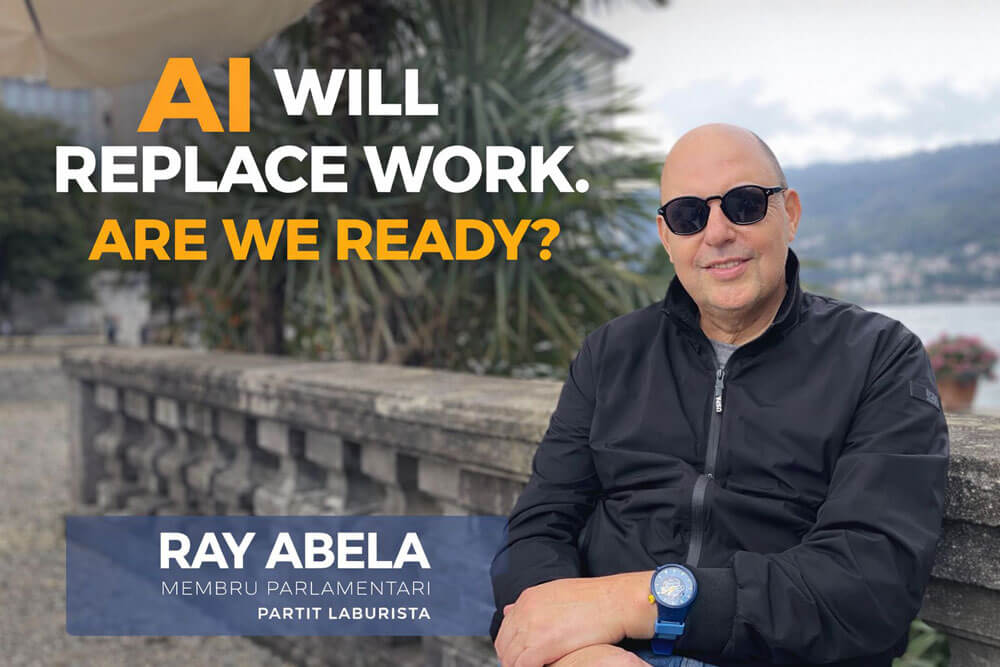
For more than four decades I have taught ICT and digital lifestyles to different generations of students. I have watched technology move from basic computing to the internet age, from smartphones to artificial intelligence. Today I observe this transformation not only as an educator, but also as a Member of Parliament, a father and a grandfather who thinks deeply about the future we are building for the next generation.
Artificial Intelligence is no longer an abstract discussion reserved for laboratories or tech companies. It is already entering our workplaces, our homes and our schools. The arrival of AI agents in particular marks a new phase where machines will not simply assist humans, but perform complete workflows on our behalf.
These systems will write, analyse, organise, schedule and execute tasks that today occupy hours of repetitive human work. They will manage documents, respond to communications, automate processes and support decision making. Productivity will increase. Efficiency will improve. Entire layers of administrative work will be shortened or removed.
This reality inevitably raises an uncomfortable but necessary question.
Will AI replace workers?
History suggests that technology rarely eliminates work entirely. Instead it changes its nature. The industrial revolution replaced manual labour with machines, yet it also created entire new industries. The digital revolution removed some clerical roles, but generated millions of new jobs in technology, services and knowledge sectors.
Artificial Intelligence will likely follow the same pattern. Certain repetitive tasks will disappear. Many roles will evolve. New professions will emerge that we cannot yet fully imagine.
But this transformation places a serious responsibility on policymakers and legislators.
Our task is not simply to regulate technology. Our task is to prepare society for it.
Education systems must adapt rapidly. Skills development must become continuous. Workers must be supported to reskill and upskill throughout their lives. Governments must invest in digital literacy not only for young people but for adults who risk being left behind.
At the same time, AI opens an important opportunity for countries like Malta that are facing growing pressure from demographic changes, labour shortages and rising population density.
If AI significantly increases productivity per worker, the economic equation changes.
A smaller workforce equipped with stronger digital tools could potentially generate higher output. Businesses may require fewer repetitive roles while focusing more on specialised skills. Workflows could be completed faster. Decision making could become more precise.
This raises another important question for our national economic model.
If productivity rises through technology, do we still need to depend on continuous growth in workforce numbers?
For years, economic expansion in many countries has been supported by importing more labour. While this has helped sustain growth, it has also created pressure on infrastructure, housing, transport and social cohesion.
Artificial Intelligence may offer a different path.
This does not mean fewer opportunities. It means different opportunities.
Flexible work models may become more common. Workers may spend less time on repetitive administrative work and more time on creative, strategic and human centred tasks. Businesses may operate with leaner teams supported by intelligent systems. Governments may deliver public services faster and more efficiently.
Yet none of this will happen automatically.
Without strong leadership, technology can deepen inequalities. Without thoughtful legislation, AI can disrupt labour markets faster than societies can adapt. Without investment in education and skills, productivity gains may concentrate in the hands of a few.
This is why the conversation about AI cannot remain purely technical. It must become social, economic and political.
As legislators we must ask difficult questions.
These are not distant questions. They are decisions we must begin addressing today.
Artificial Intelligence will not simply change how we work. It will challenge how we think about growth, labour, education and even the structure of our societies.
The real question is not whether AI will reshape our economies.
The real question is whether we will have the courage to reshape our policies around it.
As someone who has spent a lifetime teaching technology, and as a father and grandfather who looks at the future with both hope and responsibility, I believe we must approach this moment with clarity and courage.
Because the future will not belong to the countries that resist change.
It will belong to those that prepare their people to lead it.
“Artificial Intelligence will not decide the future of work. The choices we make today will.”