
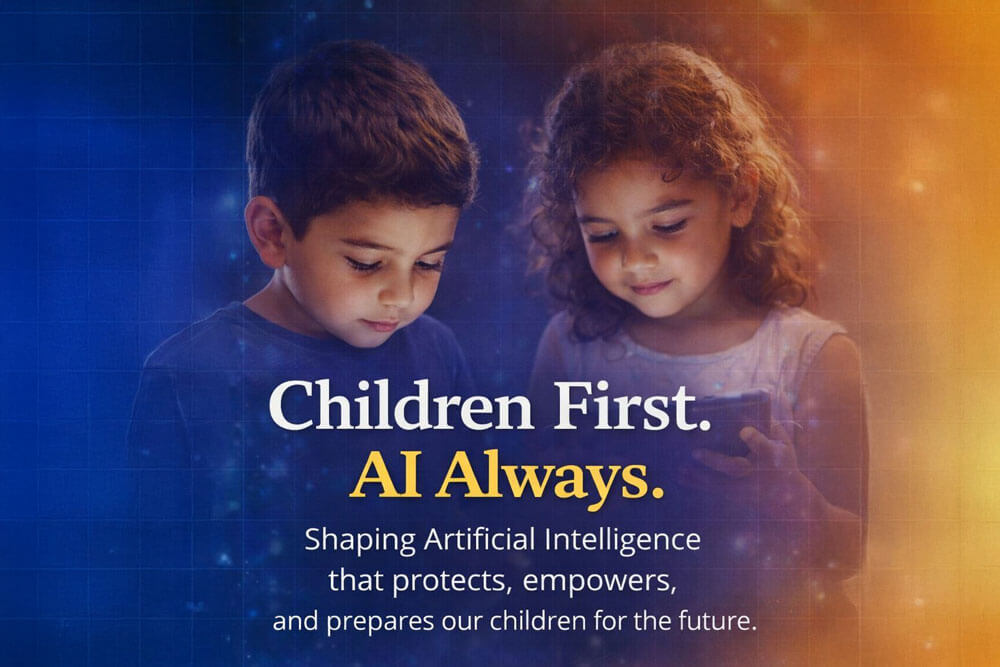
Artificial Intelligence is no longer a future concept. It is already woven into the everyday lives of our children — in the apps they use, the platforms they learn from, the games they play, and the decisions increasingly made about them. From education and entertainment to health, communication, and public services, AI is reshaping childhood in real time.
This rapid transformation brings immense opportunity, but it also carries serious responsibility. Children are not simply “users” of technology, nor are they small adults. They are developing individuals with specific rights, vulnerabilities, and needs. When AI is designed without this reality in mind, it can amplify harm, inequality, and exclusion. When designed responsibly, it can become one of the strongest tools we have to support learning, inclusion, safety, and well-being.
This publication argues for one clear principle: AI must serve children — never the other way around.
Children are among the most active users of AI-powered tools. They turn to AI for learning, creativity, problem-solving, and social interaction. Yet despite this, children are rarely included in the design, governance, or evaluation of the systems that shape their lives.
AI can personalise education, support children with disabilities, enhance creativity, and improve access to services. At the same time, it can expose children to harmful content, manipulation, privacy breaches, bias, and emotional dependency — particularly when systems are driven purely by commercial incentives or deployed without safeguards.
A child-centred approach to AI is therefore not optional. It must be built on three fundamental principles:
Every AI policy, law, and system that affects children should be tested against these principles.
Children’s safety cannot depend on warnings, fine print, or afterthoughts. It must be embedded from the very beginning — in how AI systems are designed, trained, tested, and deployed.
This means:
Of particular concern is the growing scale of AI-generated harmful content — including disinformation, cyberbullying, non-consensual imagery, and sexual exploitation material. These are not abstract threats; they are already affecting children and families.
Technology is never neutral. The choices we make in design and governance determine whether AI protects children or exposes them to harm.
AI runs on data, and children’s data is among the most sensitive data there is. It reflects identity, behaviour, development, and vulnerability. Treating this data casually or commercially is unacceptable.
A responsible approach requires:
Children should not have to surrender their privacy in order to learn, play, or participate in digital life. The responsibility to protect them lies with institutions, governments, and companies — not with children navigating systems they did not design.
AI systems can unintentionally reinforce inequality when they rely on biased data or assume a “one-size-fits-all” user. For children, this can result in exclusion — particularly for those with disabilities, from minority communities, rural areas, or disadvantaged backgrounds.
Child-centred AI must therefore:
True fairness in AI is achieved not by collecting more data indiscriminately, but by thoughtful design, representation, and accountability.
Children have a right to know when they are interacting with AI and to understand what that means — at a level appropriate to their age and maturity.
Transparency requires:
AI systems should never be designed to mimic humans in ways that confuse, manipulate, or encourage emotional dependency. Trust is built through clarity, not illusion.
Protecting children does not mean shielding them from technology. It means equipping them to navigate it confidently and responsibly.
AI literacy is no longer optional. It is a core life skill. Children should learn:
Education systems play a central role here, supported by teachers who are themselves empowered with the right tools, training, and confidence.
AI governance cannot be left to market forces alone. Governments must provide clear rules, strong oversight, and effective enforcement. Businesses must go beyond minimum compliance and embed child rights across the entire AI value chain.
This includes:
Putting children first is not anti-innovation. It builds trust, resilience, and long-term value — for society and for the economy.
AI will shape the world our children grow up in. The real question is not whether AI will be part of childhood — it already is. The question is what values we embed into it.
We have a duty — moral, social, and political — to ensure that technological progress strengthens human dignity, protects the vulnerable, and expands opportunity. Children deserve AI systems that respect their rights, support their development, and enhance their well-being.
If we get this right, AI can help raise a generation that is more informed, creative, and resilient. If we get it wrong, the cost will be borne by those least able to protect themselves.
The choice is ours.
“The true measure of AI is not how powerful it becomes, but how responsibly it shapes the lives of our children and the future they will lead.”