
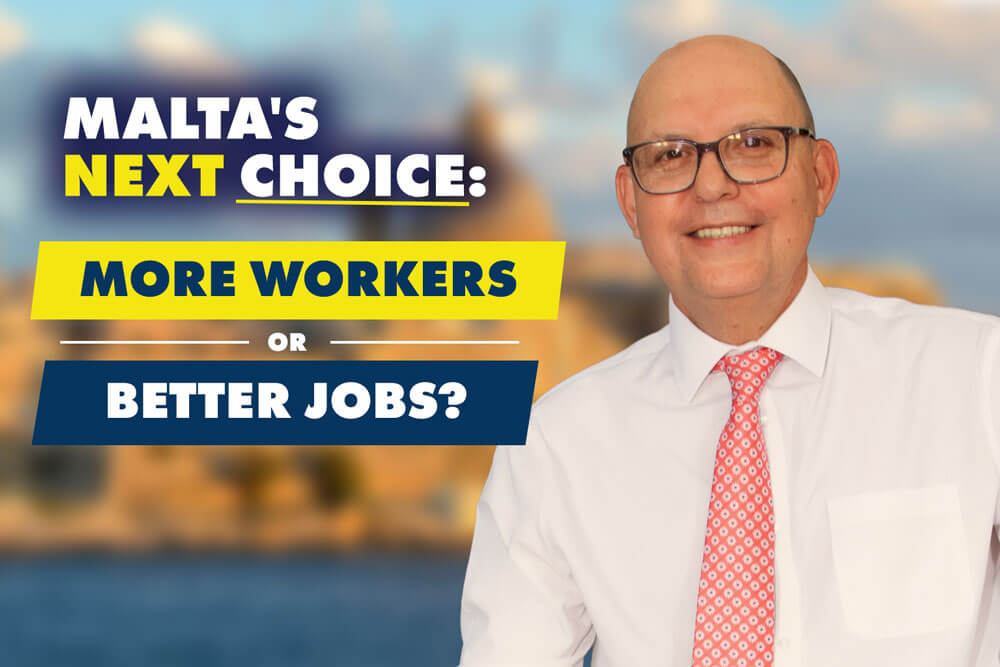
For many years Malta’s economic success has often been measured by how fast we grow and how many people we employ. Growth has brought prosperity, opportunity and investment. Yet as we look ahead to the next decade, an important national question arises: should Malta continue focusing mainly on quantitative growth, or should we now move decisively towards qualitative growth?
As a Member of Parliament, as an educator who has spent decades training generations of Maltese in technology and digital skills, and above all as a father who deeply cares about the future of Maltese families, I believe the answer is clear. I believe the next phase of Malta’s economic development must be built on quality, innovation, sustainability and productivity.
Now that Malta has effectively reached full employment, I believe we must shift our national ambition towards something even more meaningful: quality careers, better working conditions and the best possible wages for our people.
This is the dream I believe we must collectively work towards — a Malta where workers are not only employed but empowered, where talent is nurtured, where innovation is rewarded, and where economic success translates into real quality of life for families. A Malta where our youths and children can look ahead with confidence. A Malta where parents and grandparents can look towards the future with satisfaction and gratitude, knowing that the next generation will enjoy greater opportunity and dignity.
And I firmly believe that we politicians in Government must be fully geared towards this mission. Our responsibility is not simply to manage the present but to think ahead, plan strategically and shape a sustainable economic future for our country. I have always believed in being a thinker of the future — someone who studies trends, anticipates change and works today to prepare Malta for tomorrow.
The traditional quantitative model — expanding the labour force and relying heavily on imported labour — has undoubtedly supported Malta’s growth in recent years. But as a small island nation we must recognise that our long-term competitiveness cannot depend simply on increasing numbers. Instead, Malta must increasingly move towards a qualitative economic model built on innovation, knowledge, productivity and sustainability.
For many years governments around the world have relied heavily on tax credits, fiscal incentives and tax exemptions to stimulate economic activity. These tools remain useful, but they are no longer sufficient on their own to guarantee long-term competitiveness. In the coming decade Malta must adopt a more strategic approach.
We must of course continue encouraging investment and entrepreneurship, but we must simultaneously place a stronger national emphasis on investing in skills and knowledge. Tax incentives may attract investment, but skills create sustainable prosperity.
This means going beyond simply sustaining tuition fees for diplomas, degrees, master’s programmes and doctorates. These remain essential pillars of our education system. However, if we truly believe in lifelong learning, then we must begin thinking more boldly. I believe we must start exploring policies that also financially recognise and support the time people dedicate to training, upskilling and self-study.
Learning requires time, and time is often the biggest constraint for workers, parents and professionals who are trying to improve themselves while balancing work and family responsibilities. If Malta truly wants to become a knowledge-driven economy, then we must begin treating learning as a national investment rather than a personal burden.
In the same way that we have expanded policies aimed at improving population wellbeing, I believe we must extend that wellbeing agenda to include the development of skills and intellectual growth. Because the truth is simple: better skills will improve the quality of what we produce, and better quality leads to stronger productivity, stronger businesses and better wages.
At the same time, we are entering a new technological era driven by Artificial Intelligence, automation and agentic AI workflows. These technologies will transform how organisations operate by automating repetitive tasks, improving decision-making and dramatically increasing productivity.
Agentic AI refers to intelligent systems capable of performing tasks autonomously, coordinating workflows and assisting professionals in complex processes. For Malta, I see this as an extraordinary opportunity to modernise both our economy and our public services.
In healthcare, particularly in Primary Health, artificial intelligence can significantly reduce administrative burdens that today consume valuable time for doctors, nurses and healthcare professionals. AI systems can automatically generate consultation summaries, medical reports and prescriptions, allowing professionals to focus on patient care rather than documentation. Predictive analytics can help identify early health risks and support preventive medicine, while intelligent systems can manage appointments, follow-ups and patient communication more efficiently.
The same transformation can extend across government services. Citizens should not have to struggle with complicated administrative processes or unnecessary bureaucracy. Artificial intelligence can assist public administration by simplifying procedures, accelerating applications and helping people navigate services more easily.
In the business world, Artificial Intelligence can radically simplify core operations. Compliance reporting, financial analysis, logistics coordination and customer support can increasingly be automated, allowing companies to focus on what truly matters: innovation, productivity and value creation.
Technology now gives us the opportunity to eliminate systems that have become unnecessarily complex. If implemented wisely, AI can drastically reduce bureaucracy while improving the quality and speed of services.
Our goal must therefore be clear: simplify processes, automate what can be automated and deliver excellence in public and private services. Public administration should never be an obstacle for citizens or businesses. It must exist to serve people efficiently.
Because ultimately, good policy is guided by one fundamental principle: people must always come first.
In the economy of the future, learning will never stop. The traditional model where individuals study once and remain in the same profession for decades is gradually disappearing. Technology evolves too quickly. Malta must therefore build a lifelong learning ecosystem that supports workers throughout their entire professional lives.
This requires stronger digital and AI literacy from the earliest stages of education, stronger vocational and technical pathways aligned with emerging industries, flexible adult learning opportunities and continuous upskilling supported by both government and industry. In the coming decades skills will become Malta’s most valuable national resource.
The direction I am advocating aligns closely with the ambitions of Vision Malta 2050, which seeks to build a quality-driven economy based on innovation, talent, sustainability and high-value sectors. By investing in digital transformation, strengthening education and encouraging forward-looking industries, Malta can transition from a model driven primarily by labour expansion to one built on productivity, innovation and knowledge.
As someone who has spent most of his life in education and technology, I have witnessed how technological revolutions shape societies. In the late 1990s and early 2000s, when the internet was still emerging, I had the privilege of training thousands of Maltese individuals in digital skills, helping prepare our country for the digital age.
Today we stand at the beginning of an even greater transformation: the Artificial Intelligence revolution.
I firmly believe Malta must not simply follow this change — we must lead it.
Leadership requires vision, inclusivity, innovation, sustainability and the courage to think ahead. Malta has the talent, creativity and entrepreneurial spirit to succeed in this new era. But success will depend on our willingness to invest in people, invest in skills and embrace technological transformation with confidence.
As I often say:
“I helped prepare Malta for the internet revolution. Today I am ready to help Malta lead the AI revolution. Because the future belongs to those who invest in their people, strengthen their skills and have the courage to think beyond today.”