
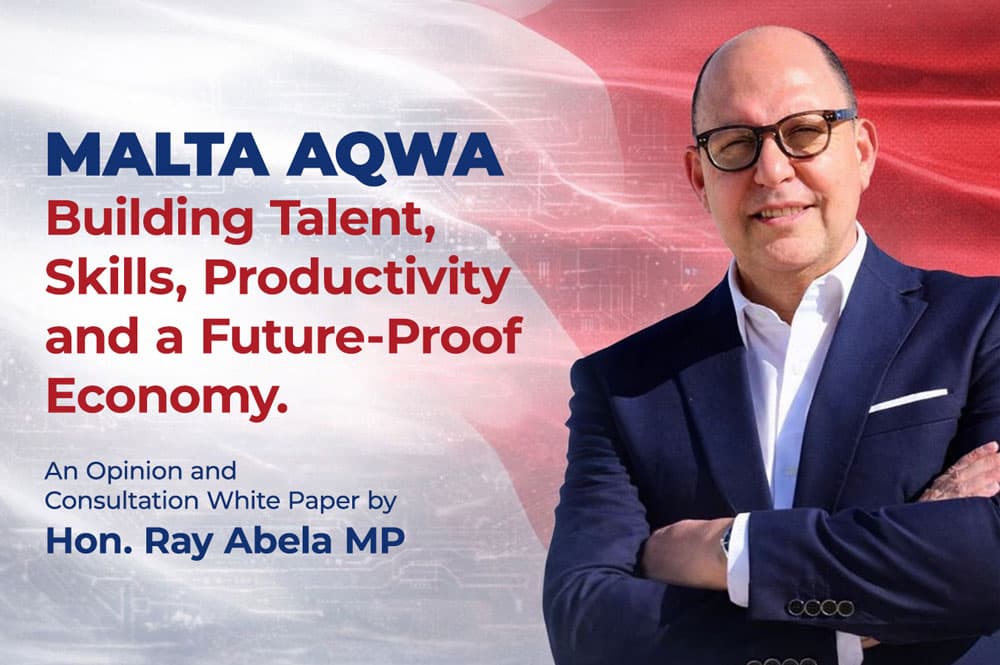
Malta stands at a decisive point in its national development.
The future will not be shaped only by how economies grow, but by how nations build talent, raise productivity, harness technology, and prepare their people to thrive in a rapidly changing world.
Artificial intelligence, automation, digital transformation and shifting labour realities are not challenges for tomorrow. They are realities of today.
The question is whether we respond incrementally — or whether we act boldly enough to shape a stronger future.
I believe this is the moment for Malta to think bigger.
This consultation on skills should not be confined to workforce planning. It should help define a broader national project: how Malta builds a future-proof economy rooted in capability, innovation, wellbeing, and talent.
That is what Malta Aqwa should mean.
Malta must move beyond treating skills as a response to shortages and begin treating them as a strategic instrument for economic transformation.
The economy of the future will increasingly reward nations that generate greater value through intelligence, innovation and productivity.
That requires a new approach.
Skills policy must now be directly linked to productivity, competitiveness and national resilience.
It must help Malta move decisively toward a quality-based economy — one that relies less on volume and increasingly on higher-value capability.
This is not simply about preparing workers for jobs.
It is about preparing Malta for the future.
If Malta is serious about lifelong learning, we must rethink how we support it.
Current funding models often focus narrowly on tuition costs or training fees.
That is no longer enough. We must recognise that learning also carries a time cost.
For many workers, professionals, parents and adult learners, the greatest barrier to upskilling is not always course fees, but the time required to study, attend lectures, prepare assessments and balance learning alongside work and family responsibilities.
This reality must be reflected in our incentive structures.
I believe Malta should modernise support mechanisms — including schemes such as Get Qualified — so they evolve beyond reimbursing fees alone and begin recognising the broader investment individuals make when committing to education.
Support structures should increasingly reflect the real economics of lifelong learning.
This would represent a major shift. And a necessary one.
Because if we want a culture of continuous upskilling, policy must support the learner, not simply the course.
Equally important is how learning itself is delivered. Our education and training systems must better reflect the realities of modern life./p>
People are balancing work.
Education models must evolve accordingly.
I strongly believe Malta should accelerate a national shift toward more flexible, digitally enabled and wellbeing-oriented models of learning, including broader recognition of high-quality online and blended pathways.
This is not about lowering standards. It is about modernising access. It is about using digital tools intelligently to make education more inclusive, more adaptable and more aligned with how people live and learn today.
I believe institutions, including MFHEA and our broader regulatory and accreditation ecosystem, should continue advancing recognition frameworks that support this evolution.
This would not be a marginal reform. It would be a leap in educational mentality. And it is progress. Because the future of learning will not be confined to physical classrooms alone.
It will be increasingly
Malta should lead that transition.
Artificial intelligence must not remain confined to ICT-related disciplines. Its implications reach every profession. Every sector. Every field of study.
That is why I believe all Faculties at the University of Malta should progressively introduce AI-related credits or units across all degree pathways.
This should not be viewed as optional enrichment.
It should increasingly become part of modern academic readiness.
Because AI is not a sector.
It is becoming a layer across all sectors. And our higher education system must reflect that reality.
But we must go further still. We must have the courage to rethink not only what we teach, but how we teach. And how we assess.
This is where the deeper reform conversation must begin. We must ask difficult but necessary questions.
These questions matter. Because education reform today is not simply about curriculum.
I believe the time has come to re-examine the full ecosystem:
Because in the age of AI, education cannot remain static.
It must evolve. And it must do so with urgency.
Ultimately, the real goal is bigger than training.
It is talent creation.
That should be Malta’s ambition. To build not simply a skilled workforce —but a talent-rich nation. A country known
That is how Malta strengthens competitiveness.
That is how Malta reduces vulnerability.
That is how Malta builds long-term prosperity.
And that is how Malta becomes truly future-proof.
I believe Malta has an opportunity to be bold.
This is not simply reform. This is nation-building.
I dream of a Malta where skills policy becomes a pillar of economic strength.
I dream of a Malta where talent is cultivated at every stage of life.
I dream of a Malta where education evolves with courage.
I dream of a Malta that leads, not follows.
I dream of Malta Aqwa.
The nations that lead tomorrow will be those that invest today — not only in technology, but in the talent, imagination and capability of their people. I will continue to insist that Malta has the courage to be one of those nations.