
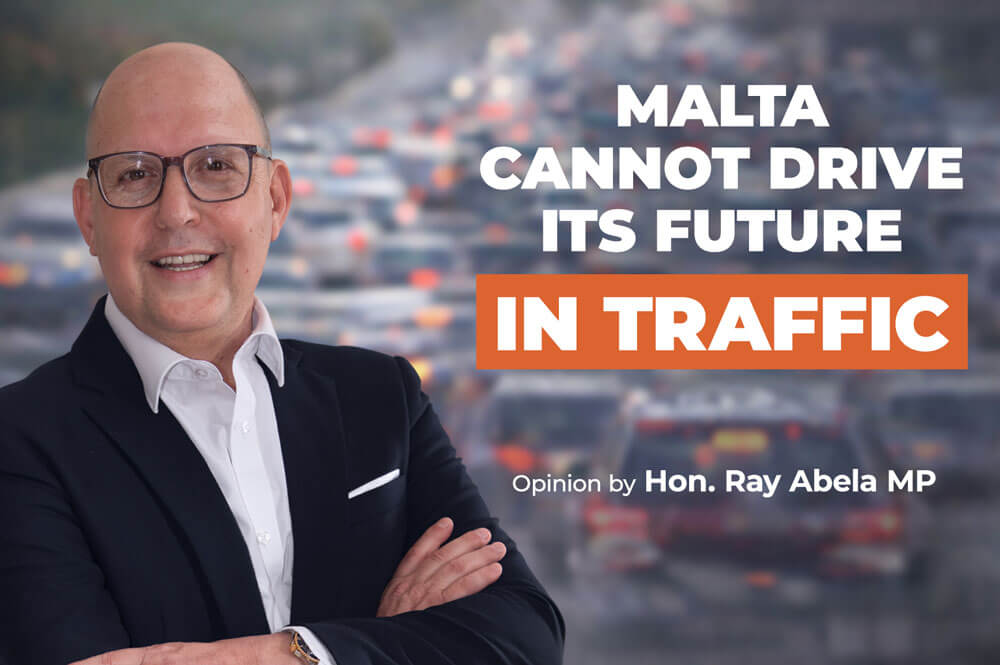
There is a limit to how long a country can pretend that daily gridlock is simply an inconvenience.
It is not. It is an economic warning.
Today Malta ranks among the most congested countries in Europe, with journeys taking significantly longer because of traffic delays. Meanwhile the number of vehicles on our roads has surpassed 450,000, an extraordinary figure for a country of our size.
This is not just a transport issue.
It is a productivity issue.
It is a quality-of-life issue.
And increasingly, it is an economic competitiveness issue.
Every morning thousands of people lose hours sitting in traffic instead of contributing productively to the economy or spending time with their families.
Malta cannot drive its future in traffic.
While we often debate infrastructure, buses, tunnels or metros, there is one solution that is frequently underestimated — yet it could have an immediate impact.
Remote working.
Technology has already transformed how we work. Many industries today — especially in digital services, finance, administration, education, technology and professional services — can operate productively from anywhere.
If thousands of workers do not need to travel to the office every single day, thousands of cars disappear from the road.
The solution is simple:
We must make remote working a national productivity strategy.
I believe Malta should introduce a structured incentive framework for companies that genuinely adopt flexible remote work models.
For example:
Companies that allow at least three days per week of remote work for eligible roles could qualify for targeted fiscal incentives.
One policy worth serious discussion is:
A reduction of up to 50% in corporate tax for companies that meet clearly defined remote-working performance indicators.
These indicators could include:
Such incentives would not be giveaways.
They would be performance-based economic tools.
If companies help reduce congestion, improve productivity and reduce environmental pressure, then the country benefits — and it is reasonable that the State shares that benefit through tax incentives.
Remote working should not be seen only as a traffic solution. It is also an economic opportunity.
It can:
Malta already promotes itself as an attractive destination for digital professionals and remote workers, supported by strong connectivity and favourable conditions for international talent.
The next step is to apply the same innovative thinking within our own national workforce strategy.
Of course, remote work alone will not solve every traffic problem.
Malta still needs:
But remote work is different from infrastructure. A flyover takes years.
A national remote work framework could reduce congestion within months.
Traffic congestion is estimated to cost Malta hundreds of millions of euros every year in lost productivity and delays.
That alone should force us to rethink the system.
Instead of accepting congestion as the price of economic growth, Malta should embrace smarter solutions that reflect how modern economies operate.
The future of work is flexible.
The future of mobility is intelligent.
And the future of Malta must be designed around both.
Because a country with ambition cannot remain trapped in its own roads.
Malta cannot drive its future in traffic.
“If we want a modern Malta, we must design an economy where technology reduces pressure on people’s lives — not one where progress is measured by the length of traffic queues.”