
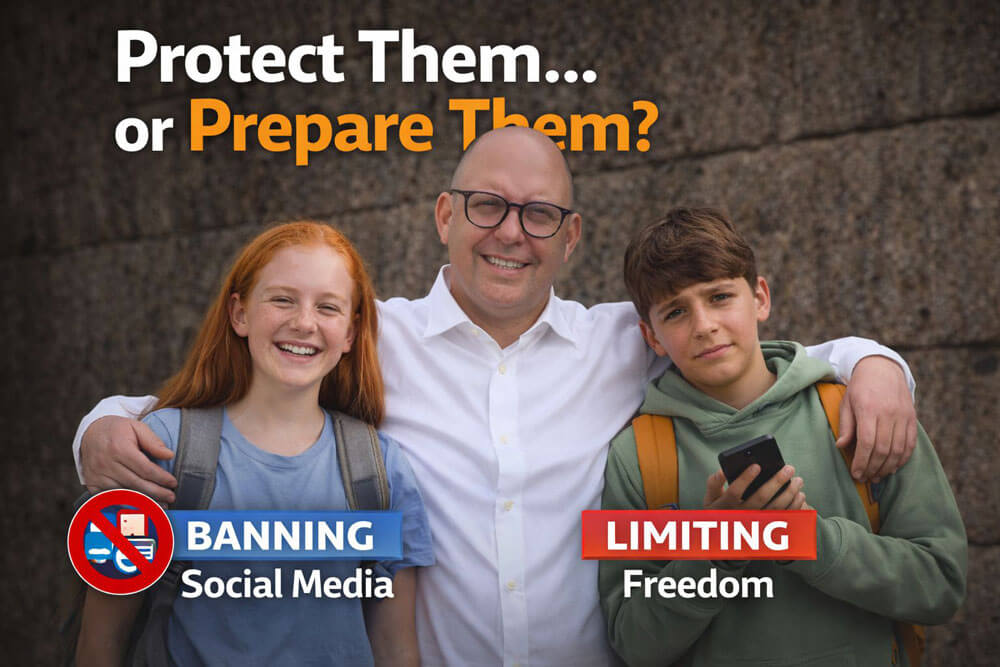
This is no longer a theoretical debate. It is a real and uncomfortable question that every society must now face.
The idea of restricting social media for children under a certain age immediately divides opinion. Some see protection. Others see limitation. And in truth… it is both.
On one side, the pros are clear and difficult to ignore.
Children today are growing up in an environment where attention is constantly interrupted. Short-form videos, endless scrolling, instant gratification — all of this is shaping how young minds think, learn, and behave. We are increasingly seeing children with reduced attention spans, difficulty focusing, and even early signs of anxiety linked to constant digital stimulation.
As an educator, I have witnessed this shift. Tasks that once required sustained thinking are now often approached with impatience. The brain is being trained for speed… not depth.
There are also growing concerns about mental health. Exposure to unrealistic lifestyles, online pressure, cyberbullying, and addictive design mechanisms are not designed with children in mind — yet children are among the most exposed.
From this perspective, setting an age limit is seen as a protective barrier — giving children time to develop cognitively, emotionally, and socially before entering a digital world that is, quite frankly, not built for them.
But then come the cons — and they are equally important.
A blanket ban does not remove curiosity. It may simply push it underground. Children today are digital natives. They will find ways around restrictions, often without guidance or supervision — which can make things worse.
There is also the argument of digital readiness. If we delay exposure too much, are we preparing them… or leaving them unprepared? Social media, for better or worse, is part of communication, identity, and even future careers.
The question is not just when they access it — but how they are educated to use it.
And yes — this is a controversial discussion. Because it touches freedom, parenting, education, and the role of the State. If you ask children themselves — especially those close to that age threshold — many will say the same thing: they want trust, not control. They want guidance, not bans. And that is where the real challenge lies.
This is not simply about age. It is about maturity, education, and responsibility. We must also confront a reality that many prefer to avoid — repetitive screen usage, particularly through fast-paced social media content, is contributing to patterns we cannot ignore. Short attention spans, reduced deep thinking, and even behavioural dependency are becoming more visible. These are not isolated cases. They are emerging trends.
So the real question is not: Should we ban?
But rather: Are we equipping our children to navigate this world?
As a father, I want protection for my children. As an educator, I want them to think, question, and understand. As a Member of Parliament, I must ensure we build a system that balances safety with preparation. Because the future will not slow down for them. We must prepare them to face it — not hide from it.
And this is where I stand. We need stronger digital education. We need parental awareness. We need ethical frameworks. We need responsibility — from platforms, from institutions, and from ourselves. Not extremes. But balance.
I WILL INSIST… that we raise a generation that is not only protected — but prepared.