
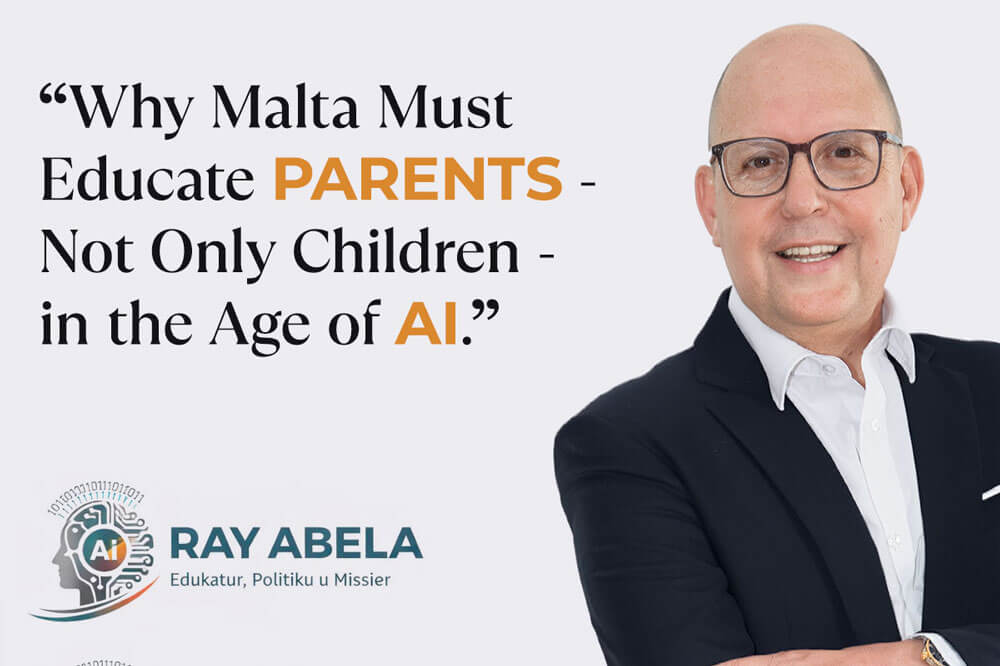
Why Malta Must Educate Parents — Not Only Children — in the Age of AI
Artificial Intelligence has quietly entered our homes. It is no longer confined to research laboratories, technology companies, or government strategy papers. Today, AI sits in the hands of our children — helping them complete homework, answer questions, generate ideas, and explore the world through conversational tools known as AI chatbots.
Across Malta, students are already using platforms such as ChatGPT, Google Gemini, Microsoft Copilot, and other AI assistants as part of their daily learning experience. For many young people, interacting with artificial intelligence feels as natural as using a search engine once did.
Yet while children are rapidly adapting to this new technological reality, many parents are understandably asking an important question: How do we guide our children safely in a world shaped by AI?
For years, public debate around online safety focused mainly on social media. Today, however, a new phase of the digital revolution demands our attention. Artificial Intelligence is not simply another online platform; it represents a fundamental shift in how knowledge is created, accessed, and trusted. The challenge before us is therefore not whether children should use AI — because they already are — but how families can learn to use it responsibly and wisely.
The answer begins with education, and specifically, education for parents.
One of the most common misconceptions is that AI chatbots operate without safeguards. In reality, major platforms already include important safety mechanisms. ChatGPT applies strong content moderation and privacy controls. Google Gemini integrates with family supervision tools such as Google Family Link.
Microsoft Copilot benefits from Microsoft Family Safety features, including activity monitoring and content filtering. Other AI systems are designed with built-in ethical constraints intended to prevent harmful outputs.
However, these protections are not always visible or understood. Unlike traditional parental-control software, AI safeguards often rely on account settings, device supervision, and informed usage rather than a single parental dashboard. This creates a gap — not in technology, but in awareness.
Many parents simply do not know what controls exist, how to activate them, or how AI differs from social media or traditional internet browsing. As a result, families risk approaching AI either with unnecessary fear or with excessive trust. Both extremes are problematic.
Artificial Intelligence is neither a threat to be avoided nor a tool to be used without guidance. It is a powerful assistant that requires human judgment.
This is why Malta should take a proactive national step by introducing an educational programme specifically designed to help parents understand AI chatbots and digital supervision in the modern age.
Such an initiative would not aim to restrict innovation or discourage use. On the contrary, its purpose would be empowerment. Parents should feel confident supporting their children as they explore technology, just as previous generations learned to guide safe internet use.
A national AI parenting programme could provide practical workshops through schools, local councils, and online platforms, explaining in simple terms how AI works, what its limitations are, and how parental settings can be applied across major systems. Parents would learn how to protect privacy, encourage critical thinking, and teach children to verify information rather than blindly accept automated responses.
Equally important is the need to promote digital balance. AI can support education, creativity, and productivity, but it must never replace independent thinking or human interaction. Children must learn that AI assists learning — it does not replace effort, curiosity, or personal responsibility.
From a broader national perspective, AI literacy is rapidly becoming as essential as digital literacy was twenty years ago.
Countries that succeed in the coming decades will not only invest in infrastructure or innovation funding; they will invest in people’s understanding of technology.
This vision aligns closely with Malta’s long-term strategy under Vision Malta 2050, which places innovation, productivity, and human-centred technological progress at the heart of sustainable economic development. Preparing our workforce for the future must begin with preparing our families today.
As Chair of the Parliamentary Committee for Artificial Intelligence and Information Technology, I firmly believe that policymaking must extend beyond regulation and economic incentives. Responsible AI adoption requires societal readiness. Laws and frameworks alone cannot ensure safe technology use; education and awareness must accompany them.
Malta has often demonstrated that small nations can lead through foresight and agility. We were early adopters in digital governance and financial innovation. We now have the opportunity to lead again by recognising that AI is not only an economic transformation but also a social one.
Educating parents about Artificial Intelligence would send a powerful message: that technological progress and human values must advance together.
Ultimately, the conversation about AI is not only about algorithms or machines. It is about trust, responsibility, and the kind of society we want to build for future generations.
Artificial Intelligence will shape tomorrow’s workforce, economy, and education systems. But the habits and values guiding its use will be shaped at home — around family discussions, shared learning experiences, and informed parental guidance.
If we equip parents with knowledge today, we equip children with wisdom tomorrow.
Because a truly smart nation is not defined by how advanced its technology becomes, but by how responsibly its people learn to use it.