
A National Framework on Bullying, Cyberbullying, Ethical AI & Digital Wellbeing.
During this week’s meeting of the Parliamentary Committee for Education, I once again placed the issues of bullying, cyberbullying, online ethics, ethical AI and digital safety at the centre of our national discussion.
Bullying no longer stops at the school gate. It follows children home through their devices, through group chats, social media, gaming platforms and AI-generated content. It affects students in State, Church and Independent schools, across primary, secondary and post-secondary levels.
The impact is emotional, psychological and sometimes long-lasting. But Malta is not starting from zero. Important and valuable work is already being carried out across our education ecosystem — and this must be recognised, strengthened and coordinated further.
Malta has strong foundations in place:
These efforts are significant. However, the rapid pace of digital transformation — particularly with AI — requires us to scale, integrate and modernize our approach.
At primary level, the focus must remain on prevention:
The good work already undertaken through Digital Literacy initiatives and Be Smart Online must be embedded further into everyday classroom practice — not as one-off sessions, but as a cultural shift.
At secondary level, the risks intensify:
Schools should:
Here, collaboration with educators — and continued professional support through MUT — becomes crucial. Teachers must feel equipped, not overwhelmed.
Young adults must understand:
Institutions should integrate AI ethics discussions across disciplines, supported by national digital literacy strategies.
Legislative amendments to the Criminal Code now clearly criminalise cyberbullying and cyberstalking.
This was an essential step. It sends a national message that:
Artificial Intelligence is now part of daily life.
Rather than banning or fearing it, we must teach:
Ethical AI discussions should run across:
As global educational research emphasises, AI ethics is not a specialist topic — it is cross-curricular and foundational.
The Directorate for Digital Literacy is well placed to coordinate such integration across all school sectors.
Digital wellbeing must form part of school culture:
Parents and grandparents must be included in this conversation. Awareness evenings, digital literacy workshops and community outreach programmes — supported by FSWS and other stakeholders — are essential.
A national conversation is needed regarding:
Such measures could:
Safeguards must respect privacy and EU regulations, but the status quo requires review.
Every school should clearly communicate:
Schools should coordinate with:
No child should feel alone. No family should feel unsupported.
Outreach remains a challenge. We must launch:
When society sees practical examples, awareness becomes behavioural change.
This week’s Parliamentary Committee on Education discussion was not symbolic — it was strategic.
Now we must:
Protection must be systematic — not reactive.
We already have strong pillars in Malta — the Department of Ethics, the Directorate for Educational Services, the Directorate for Digital Literacy, FSWS and Be Smart Online, Hotline 179, and the continued support of MUT.
Now we must bring these pillars together into a coordinated, forward-looking national strategy that addresses both bullying and the new realities of AI-driven digital life.
Protecting our children in today’s world means protecting them online as well. Safety must be embedded in culture, curriculum and community.
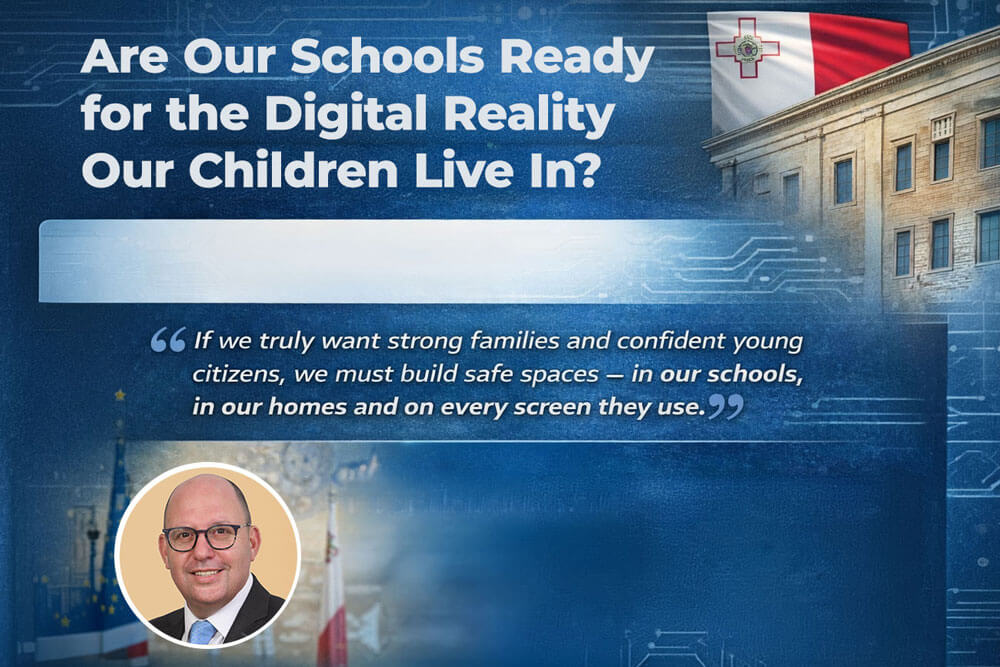
“As a Member of Parliament, an educator and a father, I know that safeguarding our children in the digital age requires more than laws — it requires leadership, collaboration and courage. If we truly want strong families and confident young citizens, we must build safe spaces — in our schools, in our homes and on every screen they use.”