
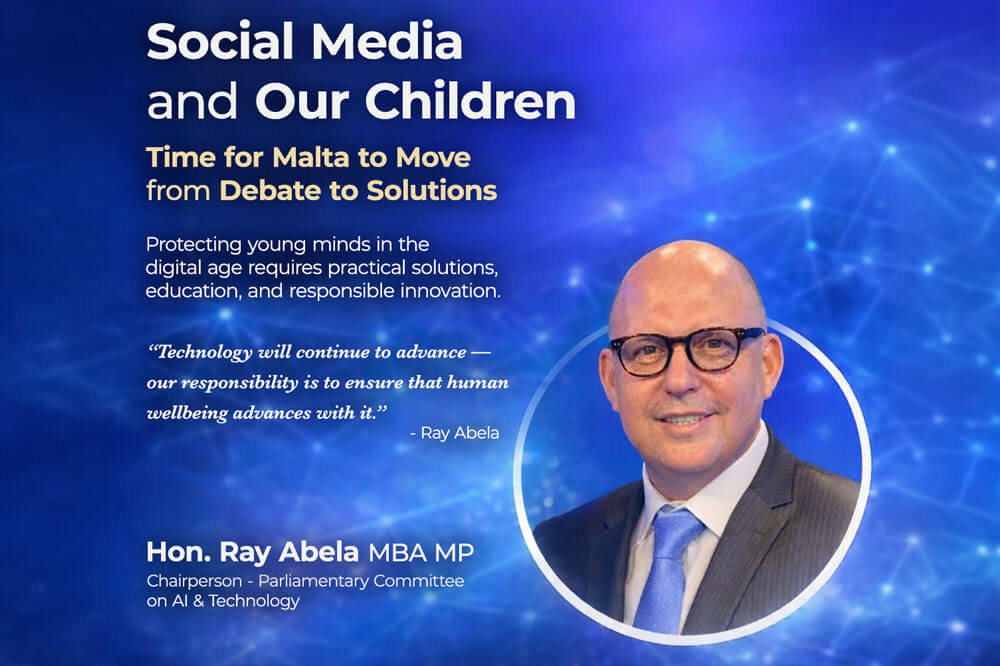
As the Public Consultation on Social Media Reform enters its final days, Malta finds itself actively participating in a wider European conversation on how best to safeguard children and young people in an increasingly digital society.
Across the European Union, policymakers, educators and families are confronting a shared and pressing challenge: how to balance innovation, freedom of expression and digital opportunity with the responsibility to protect minors from harmful content, excessive screen exposure and unhealthy online dependency.
The consultation currently underway represents an important national moment — an opportunity for parents, educators, young people and stakeholders to contribute constructively towards solutions that are proportionate, practical and aligned with European values.
Much of the international debate has focused on introducing minimum age requirements or stronger safeguards on social media platforms. Yet the real difficulty lies not in defining rules, but in enforcing them effectively.
Persuading global social media companies to redesign their platforms in line with national legislation is inherently complex, gradual in nature and often dependent on broader international coordination. For smaller jurisdictions such as Malta — whose domestic market represents only a limited share within the global digital ecosystem — influencing platform-level changes presents additional challenges.
This reality encourages policymakers to explore complementary approaches that function locally while remaining aligned with European regulatory frameworks.
Major platforms such as TikTok, Instagram, Facebook, Snapchat, YouTube and other emerging services operate across multiple legal systems simultaneously. National initiatives must therefore coexist with global technological infrastructures.
Within this context, an important policy question arises: can Malta develop a locally supported parental protection and verification tool that empowers families independently of platform redesign?
One concept worth examining is the development of a national parental verification framework integrated through local internet providers. Under such a system, when access to certain social media platforms is attempted through Maltese networks, a verification layer could confirm age eligibility or parental consent before connection is granted.
The intention would not be to replace cooperation with technology companies, but rather to complement it — providing parents with practical tools that operate within Malta’s own digital environment.
Such an approach could potentially strengthen parental oversight, support age-related safeguards discussed in legislation, and simplify enforcement mechanisms at a local level.
Any proposal of this nature must be carefully assessed within the European legal framework.
Key considerations include compliance with EU open internet and net neutrality principles, strict adherence to GDPR and privacy protections, proportionality requirements under the Digital Services Act, and safeguarding fundamental freedoms, including access to information.
These questions require detailed examination by legal experts, technologists and regulators. The objective must remain balanced: protecting minors while respecting rights, maintaining trust and preserving democratic values.
Regulation and technology alone cannot resolve over-dependence on social media. Education and awareness must remain central pillars of any meaningful reform.
Malta should continue strengthening initiatives that bring together teachers, parents and students to promote digital wellbeing, responsible online behavior and healthier screen-time habits.
Many families may not realise that platforms already provide protective tools, including Apple Screen Time and Google Family Link for device-level controls, TikTok Family Pairing, YouTube Kids environments, Instagram Teen Account protections and Snapchat Family Center supervision tools.
The tools exist — but are we fully aware of them, and are we using them effectively?
If children were asked to disconnect from the internet for just one day, would they manage? Perhaps the same question applies equally to adults, as constant connectivity increasingly shapes both our professional and personal lives.
Artificial Intelligence — Progress but Not a Complete Answer
We now live in the age of Artificial Intelligence, where platforms deploy AI systems to detect harmful videos, graphics and text related to violence, exploitation or self-harm. AI moderation and chatbot safeguards are improving rapidly, increasingly blocking dangerous prompts and inappropriate material.
This represents meaningful progress — but it is not a complete solution.
Technology can assist moderation, but it cannot replace parental guidance, education, ethics and human judgement.
Digital platforms will continue to evolve, and new services will inevitably emerge. Technology advances at a pace that often exceeds legislative cycles.
If action is delayed, societies risk continuously adapting after challenges have already materialised. Responsible governance therefore requires anticipation rather than reaction.
The ongoing Public Consultation gives Malta an opportunity to contribute constructively to the European dialogue — exploring innovative yet balanced approaches that protect children while embracing digital opportunity.
Our goal should not be to restrict technology, but to ensure that technological progress develops in harmony with human wellbeing, democratic values and the interests of future generations.
“Technology will continue to advance — our responsibility is to ensure that human wellbeing advances with it.” - Ray Abela MP