
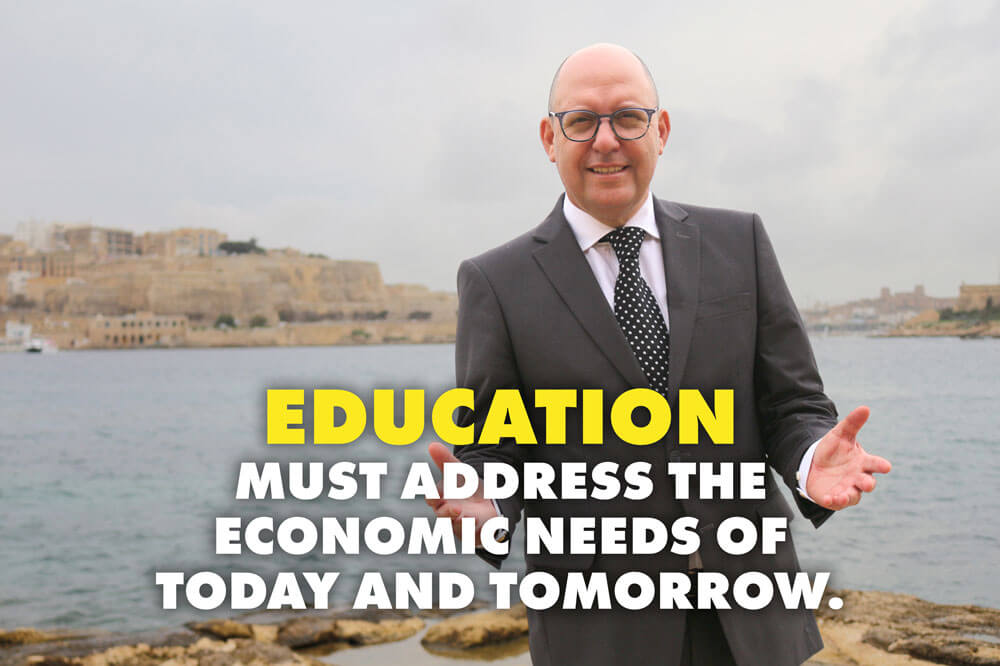
In education policy we often hear powerful words: strategy, sustainability, consultation, reform, progression. They sound important. They sound responsible. They sound dynamic. But the real question is simple: when do these words become action?
Because while we continue discussing strategies and launching consultations, the world outside our classrooms is moving at extraordinary speed. Technology is not waiting for policy papers. Artificial Intelligence is not waiting for committee meetings. And our children certainly cannot wait.
For decades, education systems were designed around one central idea: memorisation of information. Students were expected to remember facts, formulas and definitions because access to information was limited. But today information is everywhere.
Every student carries access to global knowledge in their pocket. Search engines, AI systems, digital libraries and global platforms have fundamentally changed how knowledge works.
So we must ask an honest question. Why are we still teaching students to memorise information when information is available everywhere?
The real skill of the future is not memorising answers. The real skill is asking the right questions.
In the age of Artificial Intelligence, the people who will succeed are those who know how to guide systems, ask intelligent questions and interpret results.
In simple terms: the future belongs to the best prompters.
And this applies to every profession. Not only teachers.
The pattern is clear. The future will reward those who can think, question, interpret and innovate, not those who simply memorise.
This is why education must evolve from knowledge transmission to knowledge navigation.
As a Government we are doing the right thing by investing in devices, digital platforms and tools for our students. Equipping children with technology is an important step in preparing them for a modern digital world.
But let us be honest. Devices alone will not transform education. The real transformation must happen in how we teach, how we learn and how we prepare young people for the future.
Education must become more dynamic. It must encourage exploration, creativity, critical thinking and innovation. Students should be challenged to solve problems, develop ideas and build solutions, not simply reproduce information from textbooks.
This means turning the many strategies, consultations and frameworks we produce into clear, concrete actions that create real opportunities for our children and youths.
Because the biggest danger today is not technological change. The biggest danger is institutional slowness.
Education systems often move slowly, cautiously and bureaucratically. Technology moves exponentially. And if decision-makers move slower than technology itself, we risk preparing students for a world that no longer exists.
Those at the helm of policy must recognise this urgency. We must act faster than the speed of change. Not recklessly, but decisively.
Because the future will not wait for us to finish another consultation document.
As someone who has spent a lifetime working in education, technology and skills development, I firmly believe that Malta has the talent, the institutions and the ambition to lead. But leadership requires courage. It requires turning big words like strategy, sustainability and progression into short-term actions that unlock long-term opportunity for our young people.
Our mission must be clear. Not to prepare students for exams. But to prepare them for the future they will build.