
For more than four decades I have taught ICT and digital lifestyles to students, adults, workers and parents. I witnessed the arrival of the internet. I saw the mobile phone reshape how we communicate. I saw social media redefine how young people live.
Today we are facing a transformation far greater. Artificial Intelligence. And I want to say something that may sound uncomfortable to some.
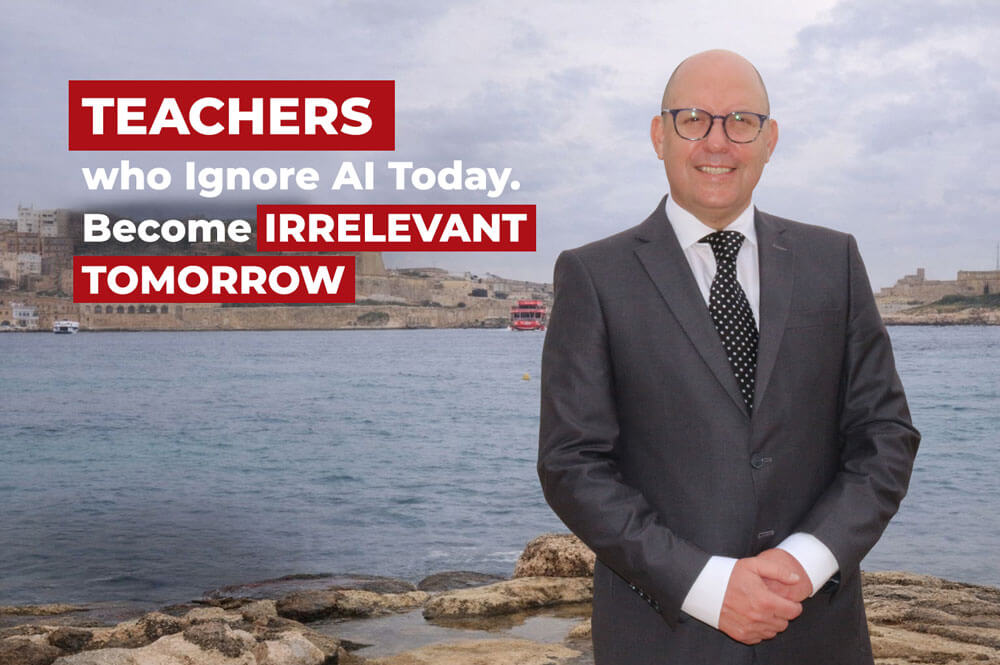
Artificial Intelligence will not replace teachers. But teachers who ignore Artificial Intelligence risk becoming irrelevant in the education system of tomorrow. This is not speculation. It is already happening.
Across the world classrooms are beginning to change. Artificial Intelligence can assist in preparing learning material, analysing where students struggle and generating personalised exercises for each learner. Many of the tasks that once consumed hours of teachers’ time can now be supported by intelligent systems.
This does not eliminate the teacher. It transforms the role of the teacher.
Education can no longer remain built around a simple model where the teacher explains and the student listens. Today students have immediate access to information. In seconds they can ask questions, receive explanations, analyse data, generate code or explore complex concepts.
There is a truth we must be honest enough to recognise. If education remains focused only on delivering information, machines will eventually do that better. But education was never meant to be about information alone.
Education is about guidance, judgement, empathy and intellectual challenge. No machine can read the face of a student who is confused, discouraged or about to give up. Only a teacher can do that.
The real risk therefore is not Artificial Intelligence. The real risk is an education system that refuses to evolve. If schools treat AI as a threat, students will still use it. If we try to ban it, it will simply be used in secret. If policymakers ignore it, education risks becoming disconnected from the real world.
As a father this concerns me deeply. Our children are already growing up in a world where Artificial Intelligence writes, designs, analyses and creates.
The question is no longer whether students will use AI. The real question is whether education systems will teach them how to use it responsibly and intelligently. The teacher of the future will not compete with Artificial Intelligence. The teacher of the future will lead it.
I can imagine classrooms where Artificial Intelligence provides personalised exercises for each student, identifies where learners need support and frees teachers from repetitive administrative tasks.
This allows teachers to focus on what technology cannot replace.
Artificial Intelligence therefore has the potential to become the most powerful assistant teachers have ever had.
However this transformation is not only technological. It is also political.
Education systems must rethink how teachers are trained, how digital literacy is integrated, how Artificial Intelligence ethics is taught and how students are assessed in a world where intelligent tools are part of everyday life.
If we fail to adapt education for the age of Artificial Intelligence, we risk preparing a generation for a world that no longer exists. That would be one of the greatest failures of leadership.
As a Member of Parliament, as an educator and as a father, I believe we must speak honestly. We cannot defend yesterday’s system while claiming we are preparing tomorrow’s generation. We must build an education model where human intelligence works together with Artificial Intelligence.
Because the classroom of the future is already emerging.
The real question is whether we are ready for it. I believe we must be. And we must begin now.
The future will not belong to those who fear Artificial Intelligence. The future will belong to those who teach the next generation how to master it.
“Artificial Intelligence will not replace teachers. But it will reveal which teachers are ready for the future.”