
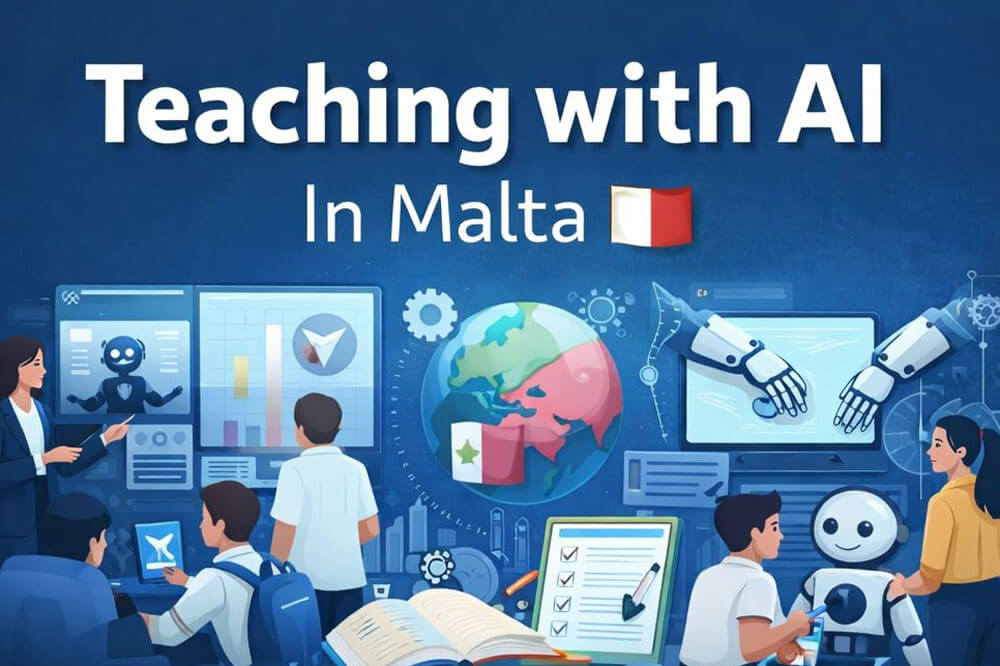
Are we moving forward with purpose — or taking AI in education too lightly?
Artificial Intelligence is already reshaping how we work, communicate, receive healthcare, and run businesses. Yet in education, an uncomfortable but necessary question remains:
Are we truly integrating AI with purpose — or are we approaching it too cautiously, unevenly, and sometimes superficially?
Malta has strong digital foundations and committed educators, but foundations alone are not enough. What matters now is pace, confidence, and coherence.
AI is already present in education — but its use is inconsistent.
This creates a growing AI divide between schools, subjects, and most importantly, students.
These risks increase when AI is avoided — not when it is taught properly.
Traditional homework is increasingly outdated in an AI-enabled world. Homework should shift from repetition to thinking.
Clear guidance on what is encouraged, acceptable, and not allowed.
Integration in languages, science, maths, arts, ethics, and more.
Continuous, practical, and classroom-based upskilling.
Taskforce including educators, parents, and technologists.
From fear and uncertainty to trust and empowerment.
AI will not replace teachers. But education systems that fail to evolve will fail students.
Malta has the opportunity to lead — not follow. What is needed now is courage, clarity, and conviction.
“The real risk in education today is not using AI — it is pretending it doesn’t exist. Our duty is to teach students how to think with technology, not hide from it.”